


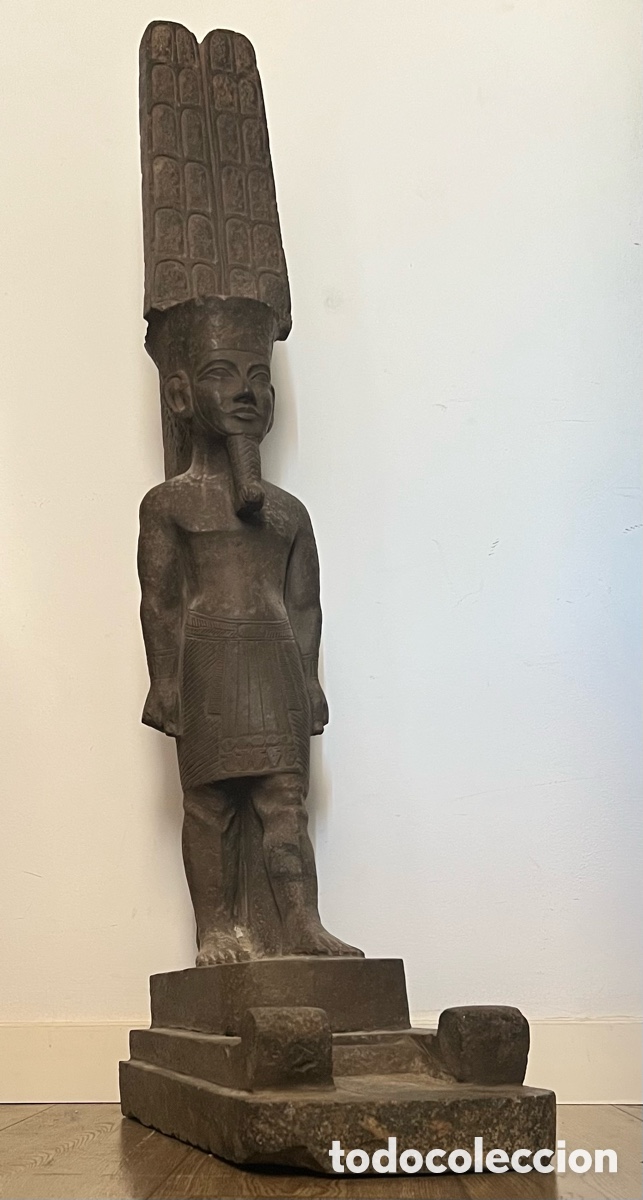
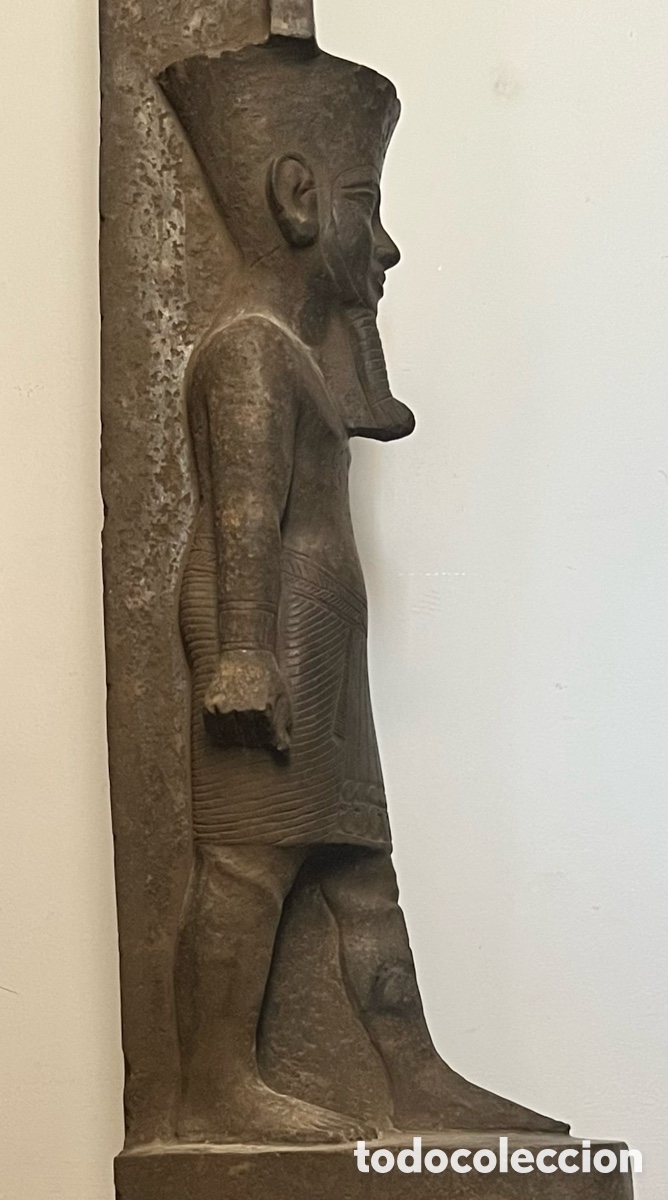
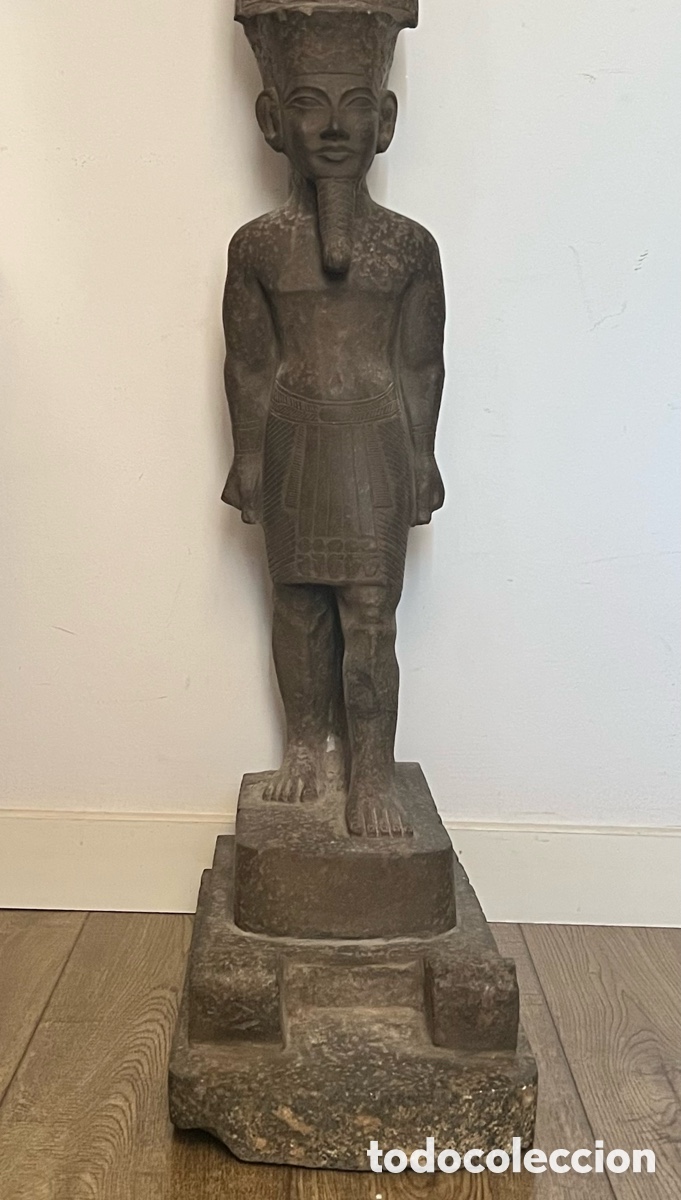
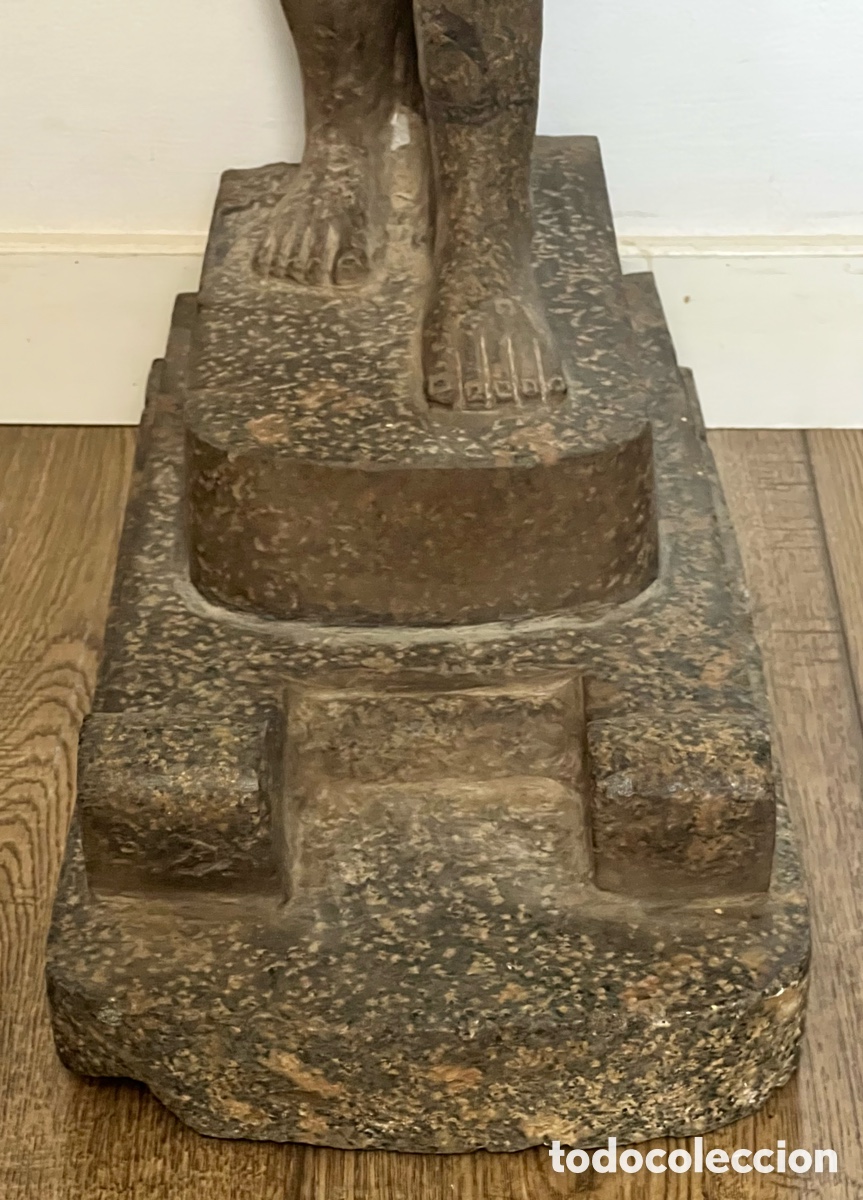
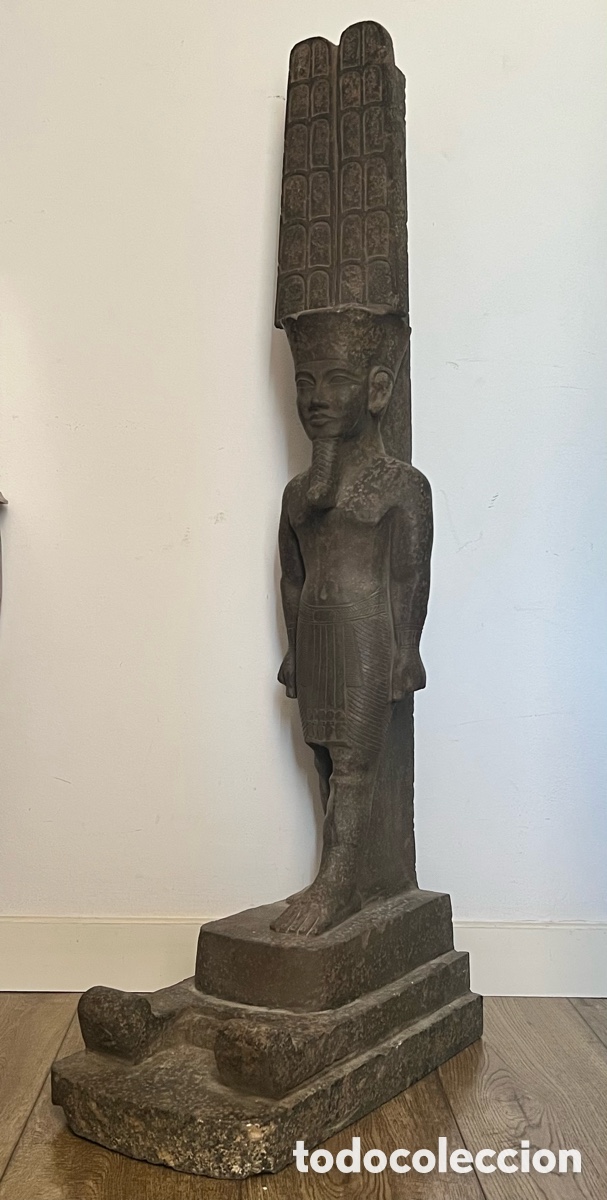
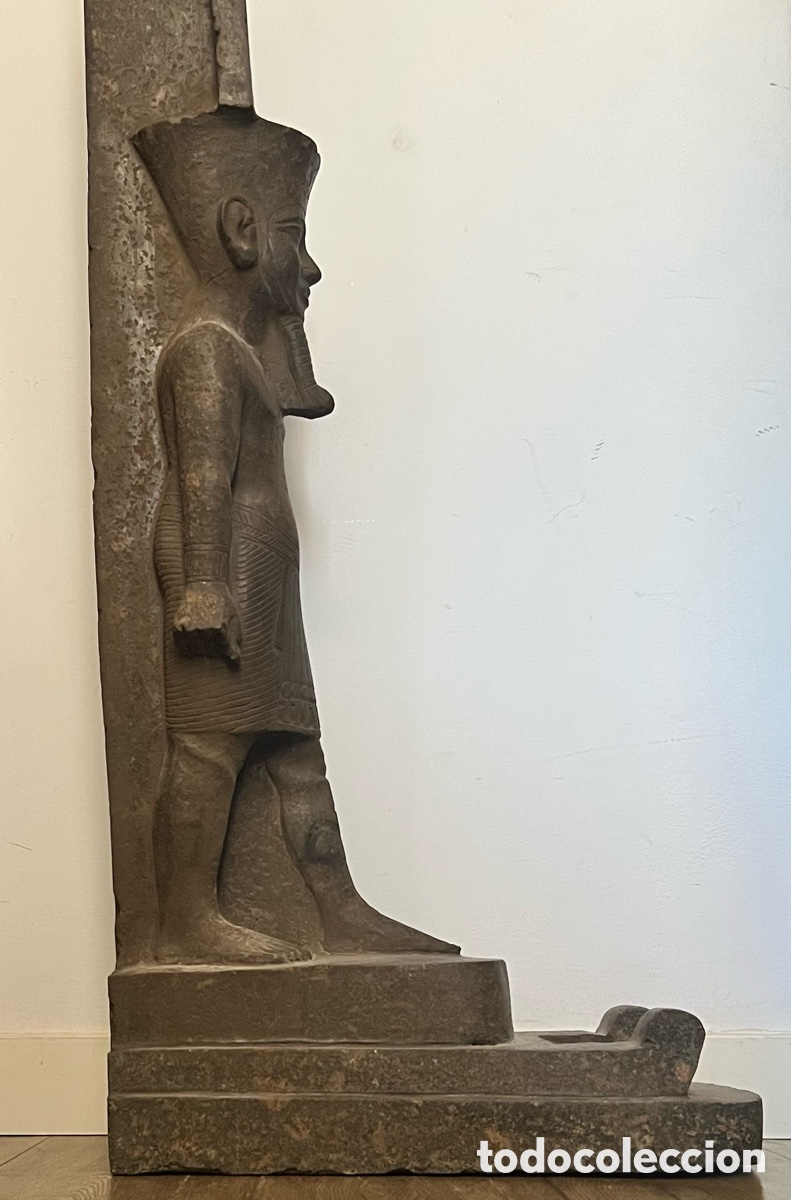
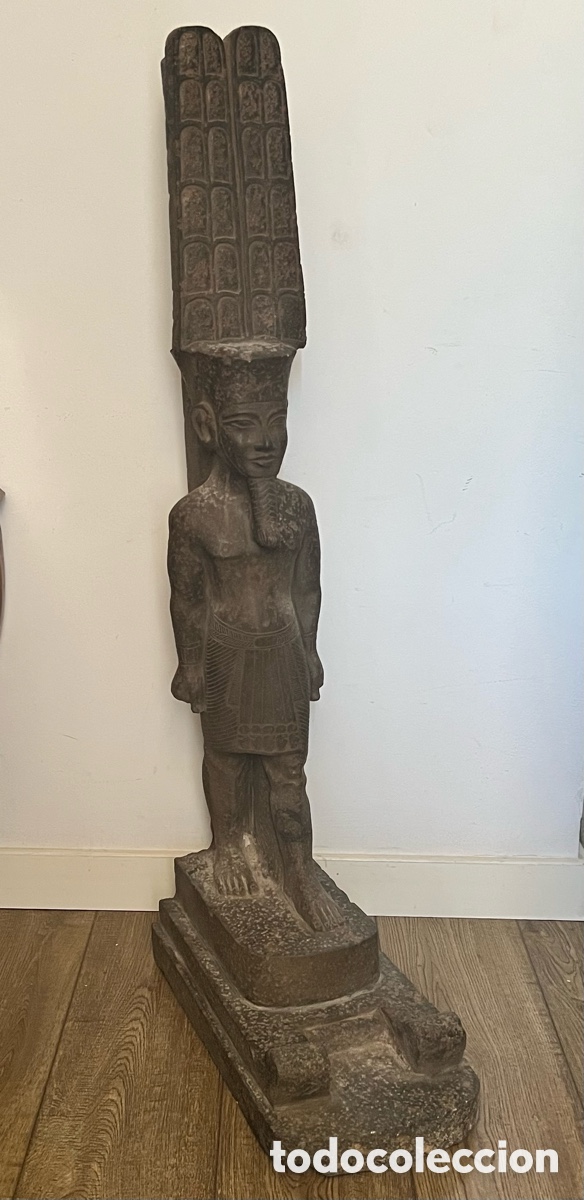
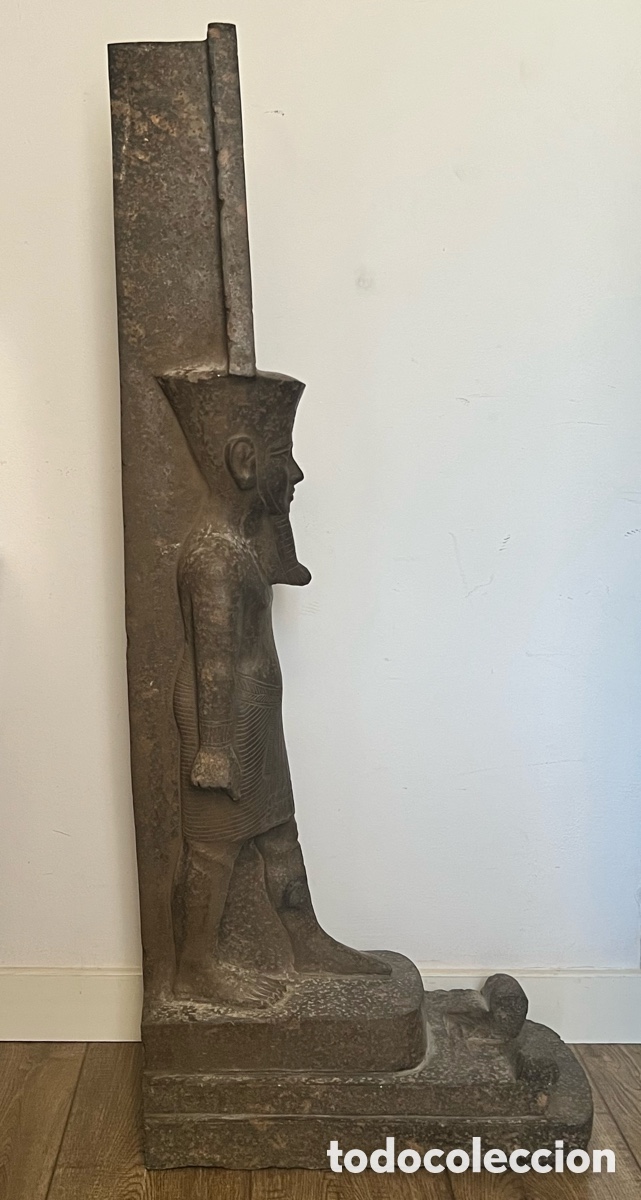
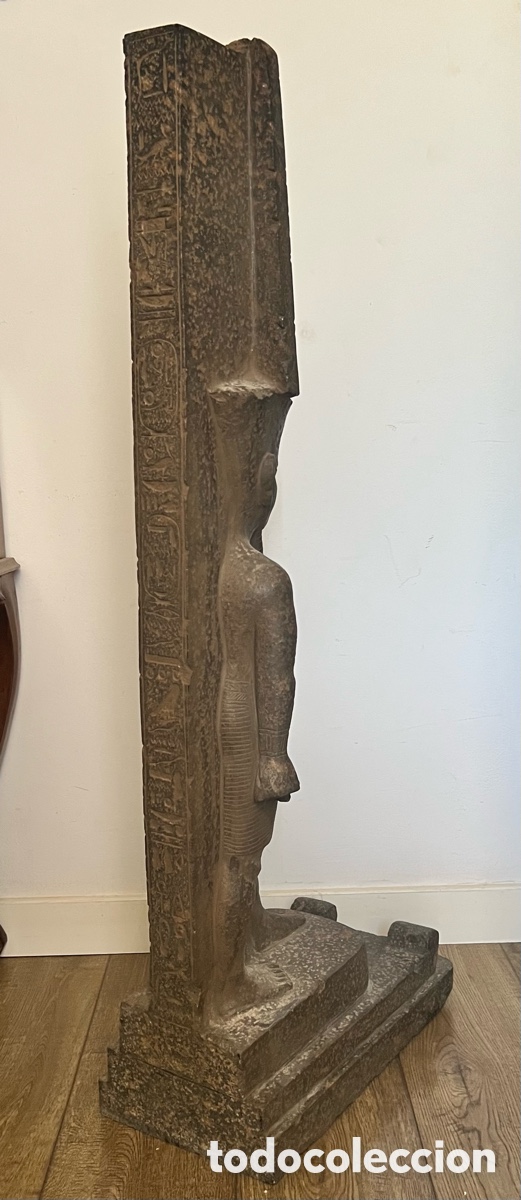
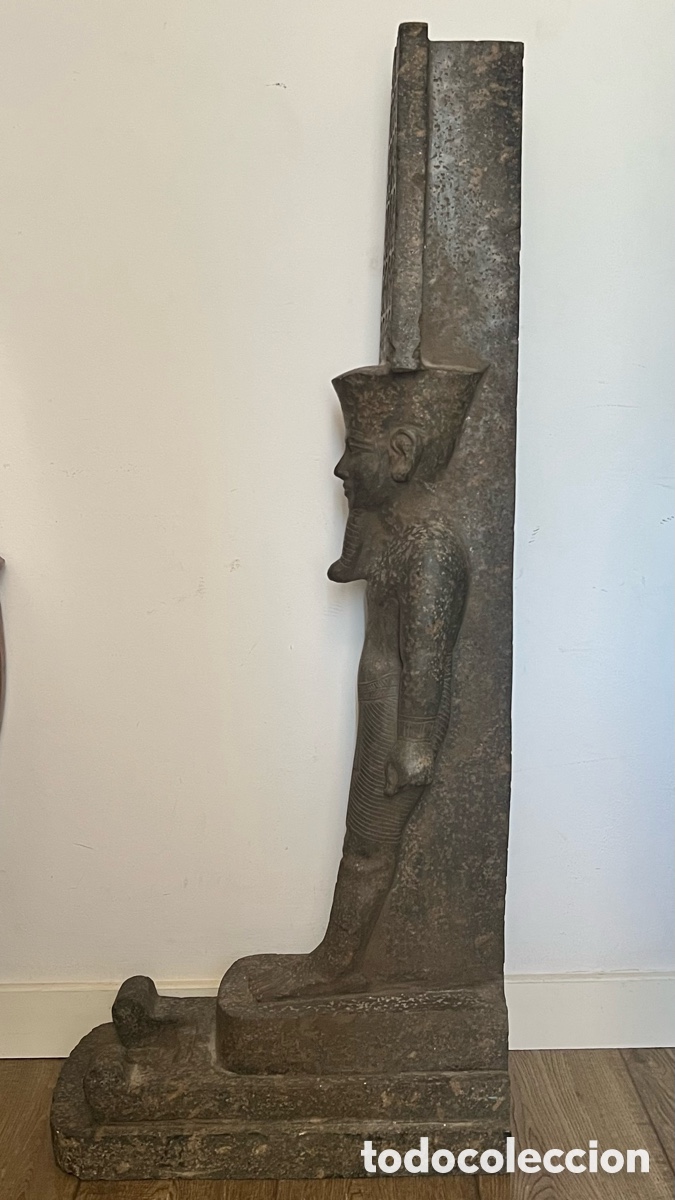
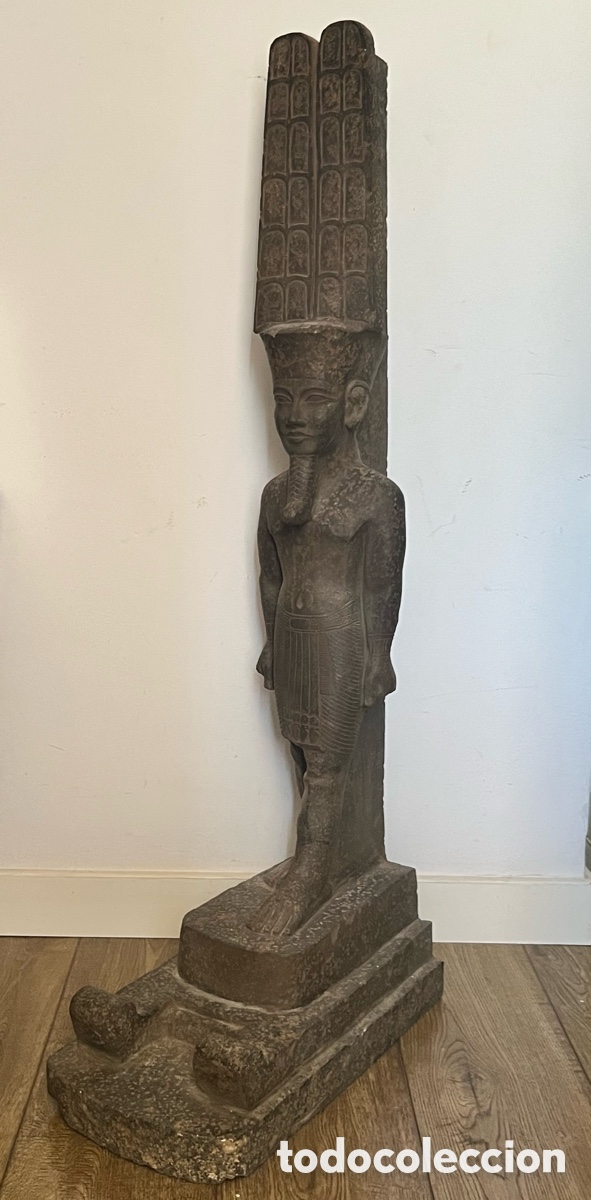
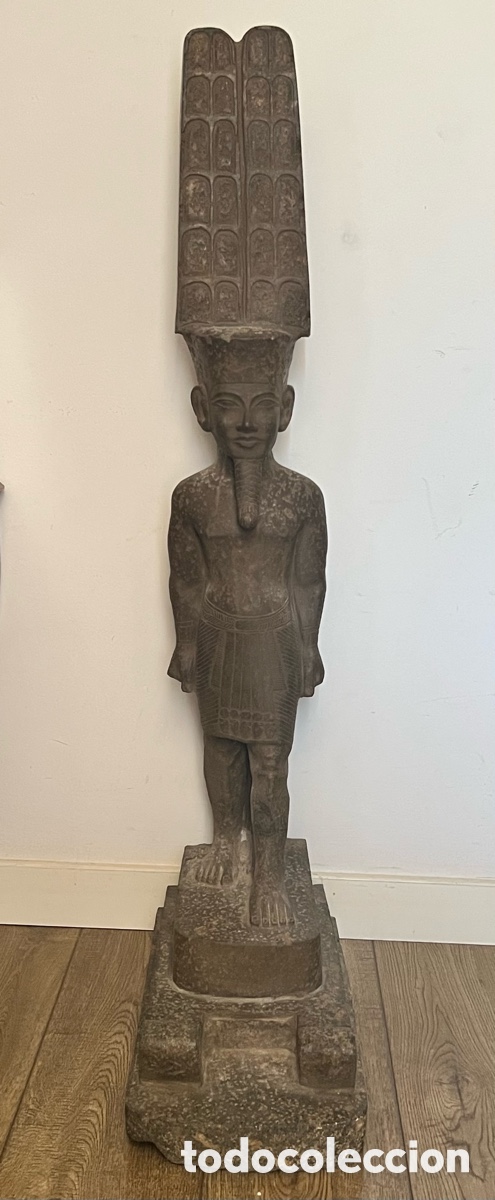
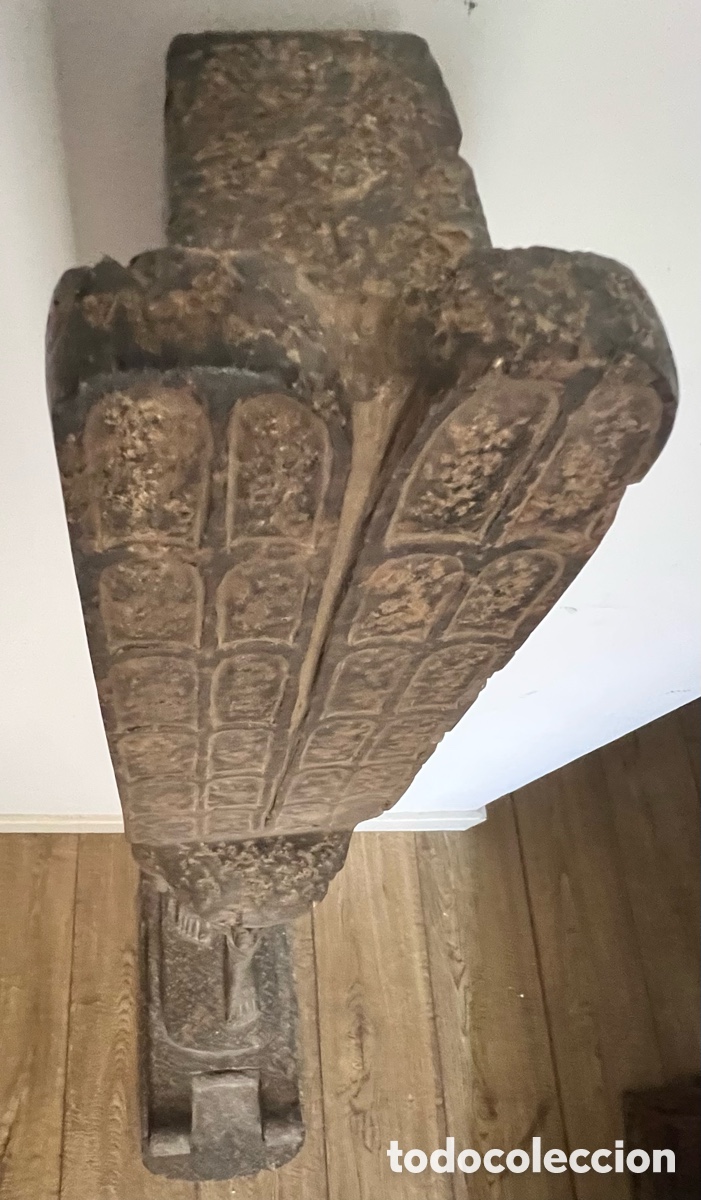
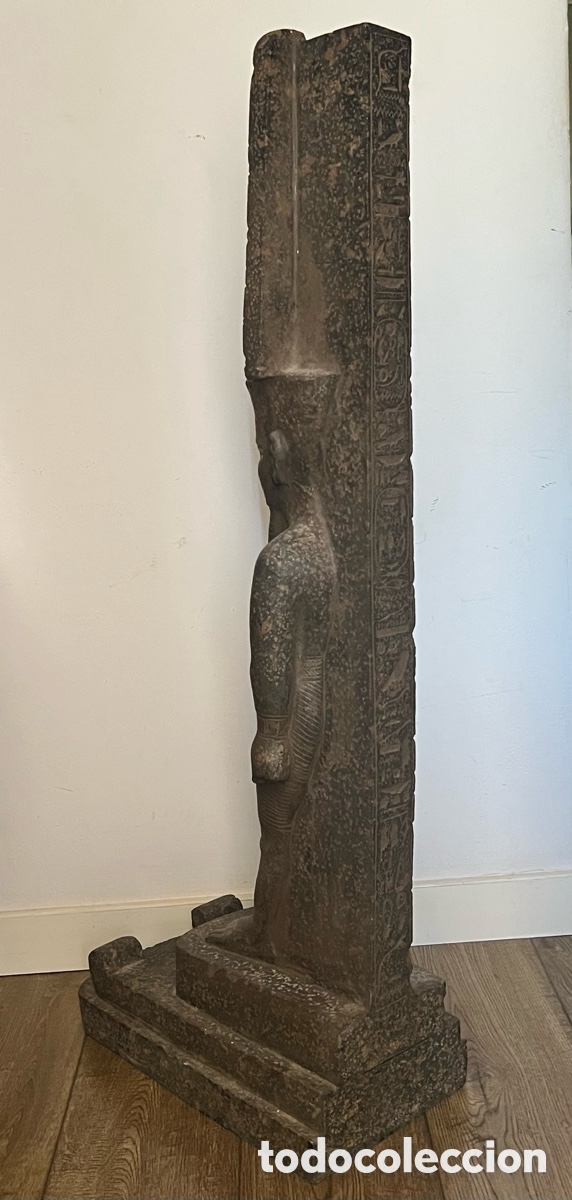
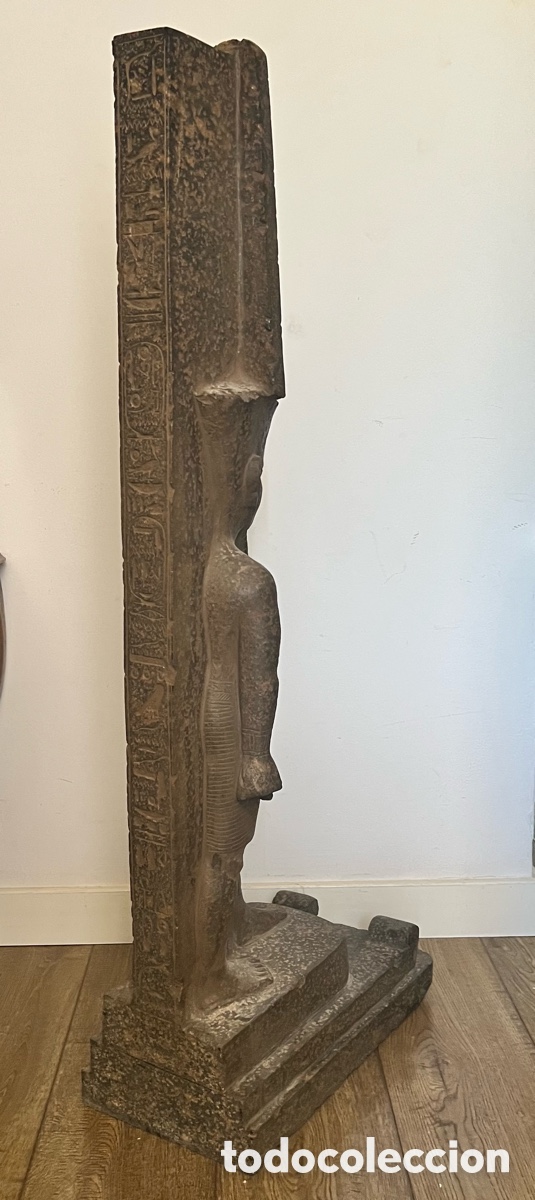
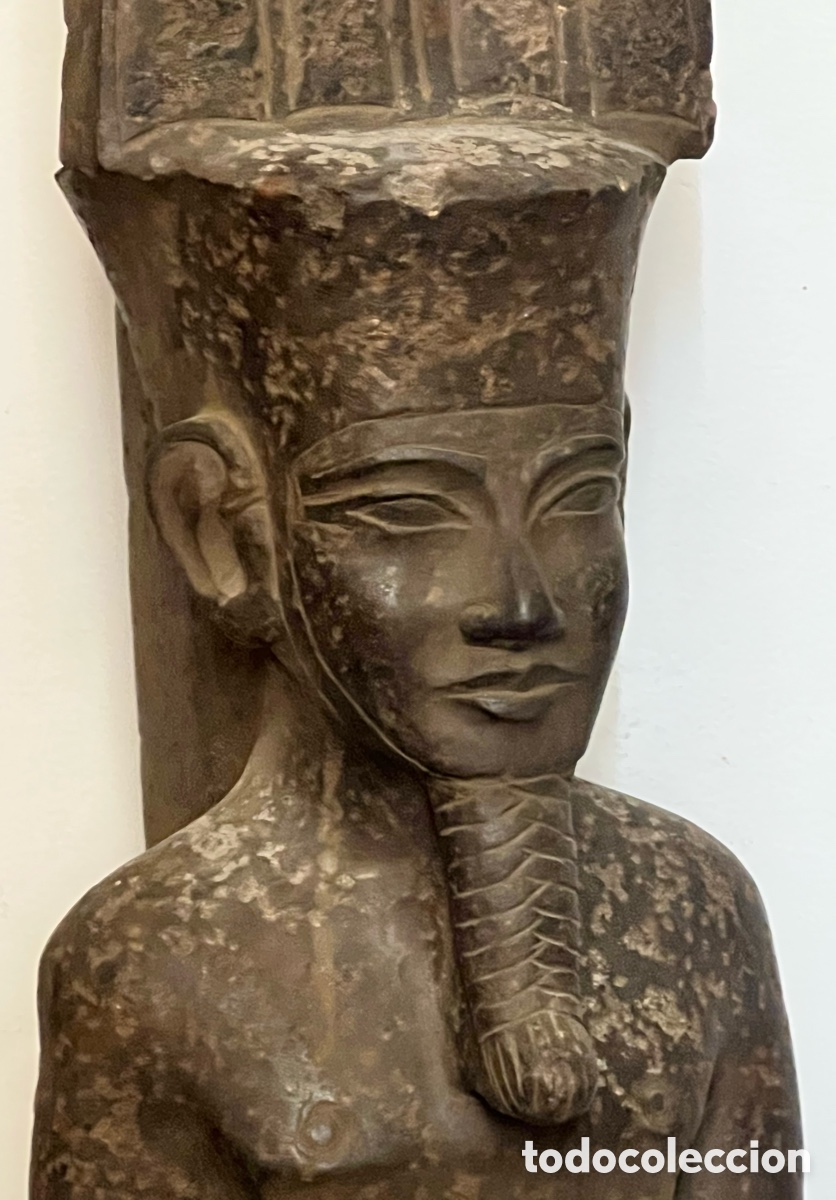
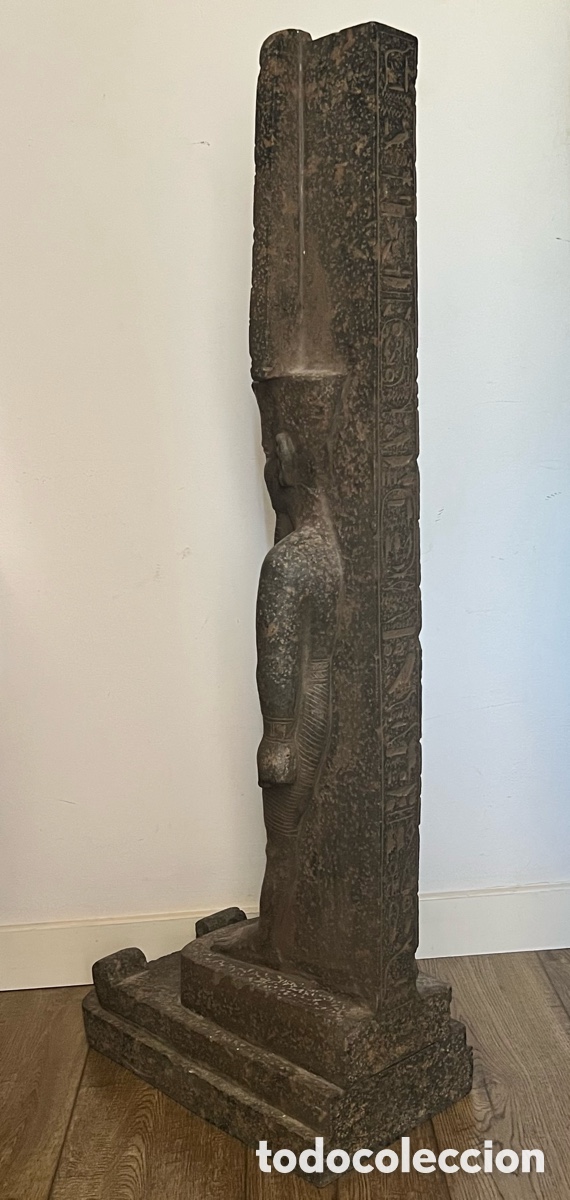
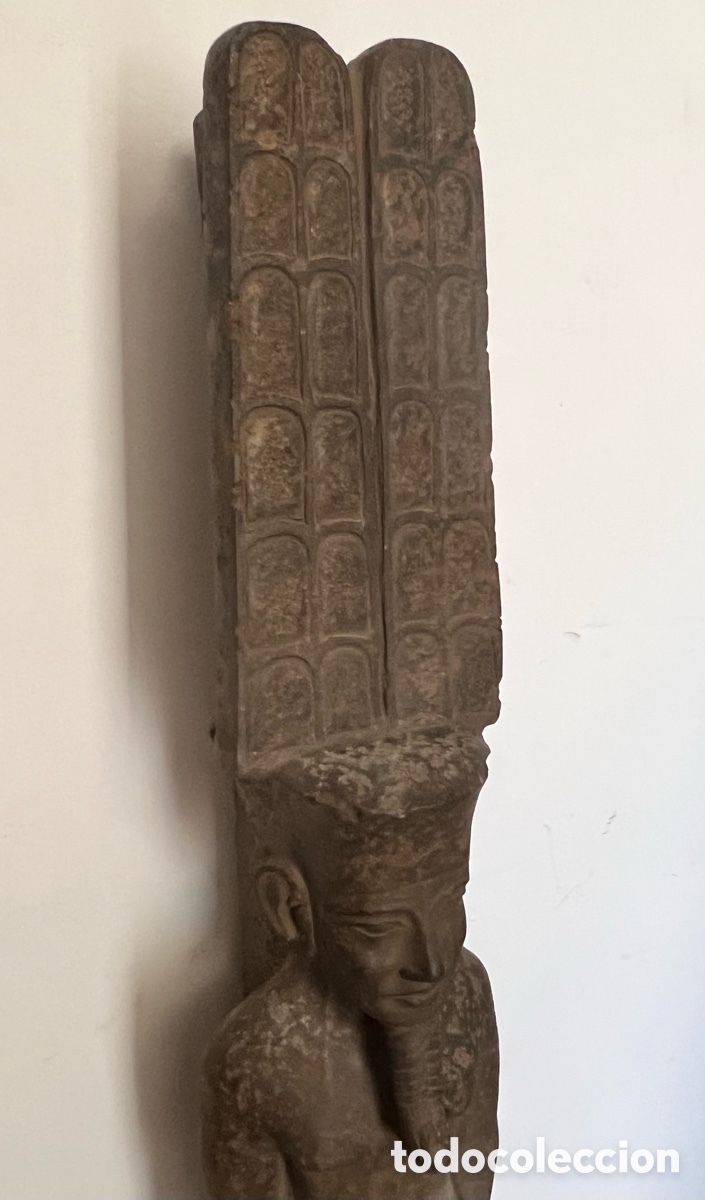
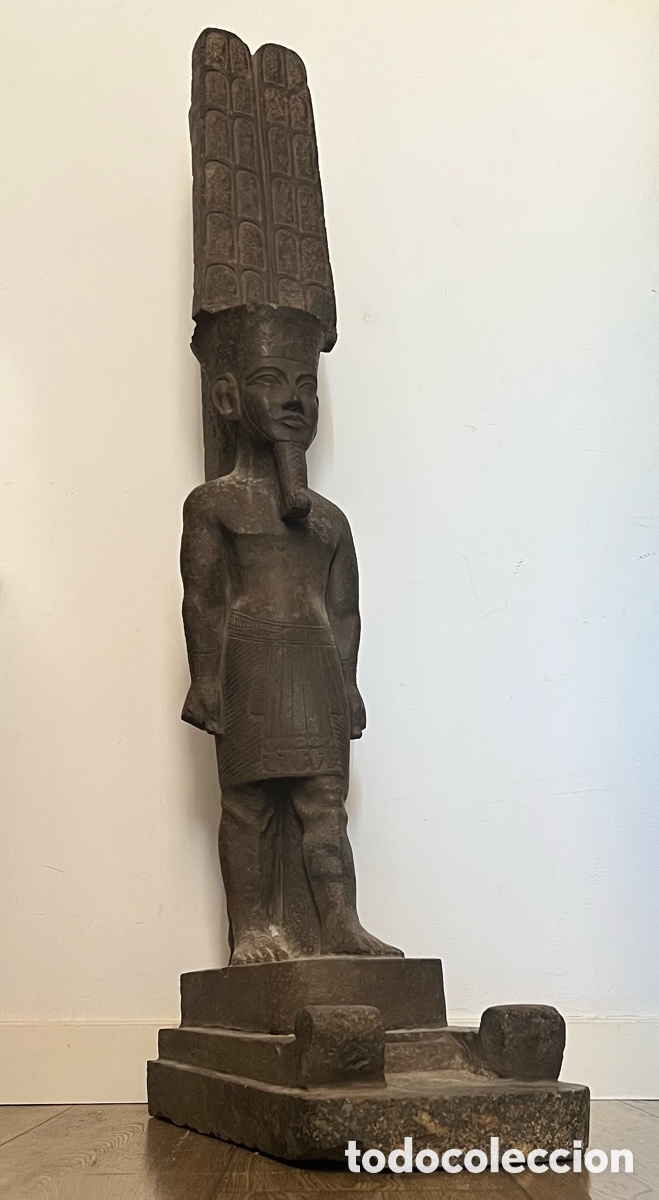
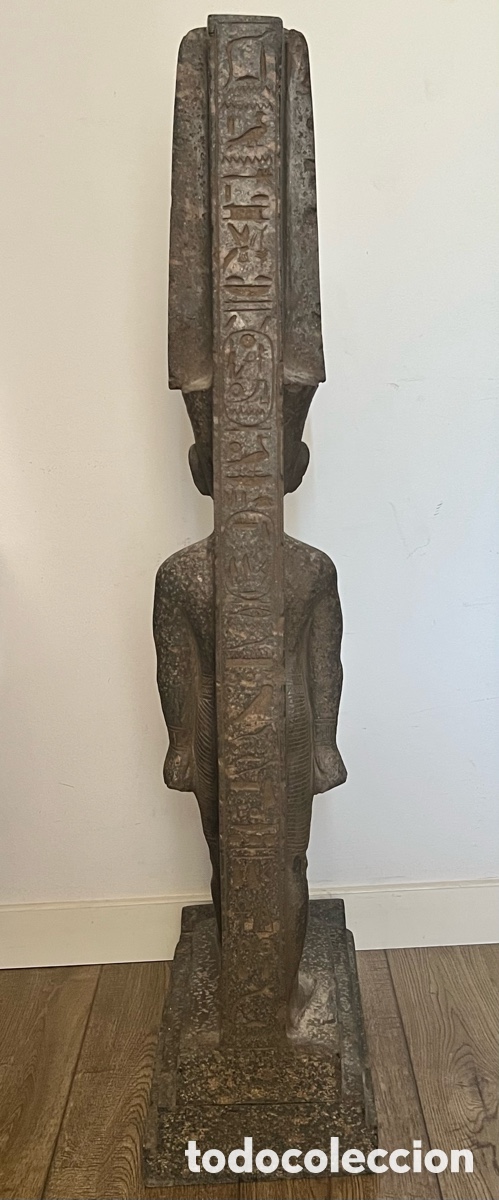
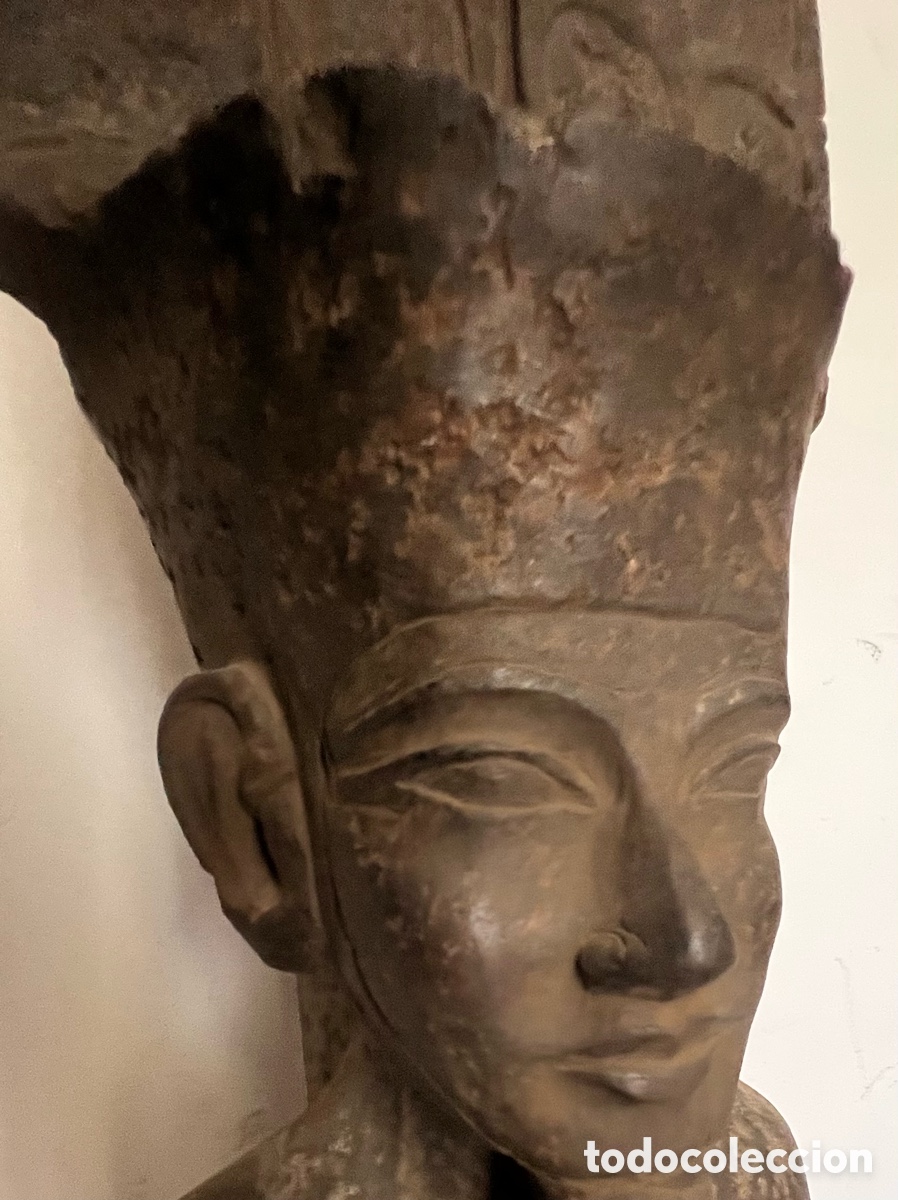
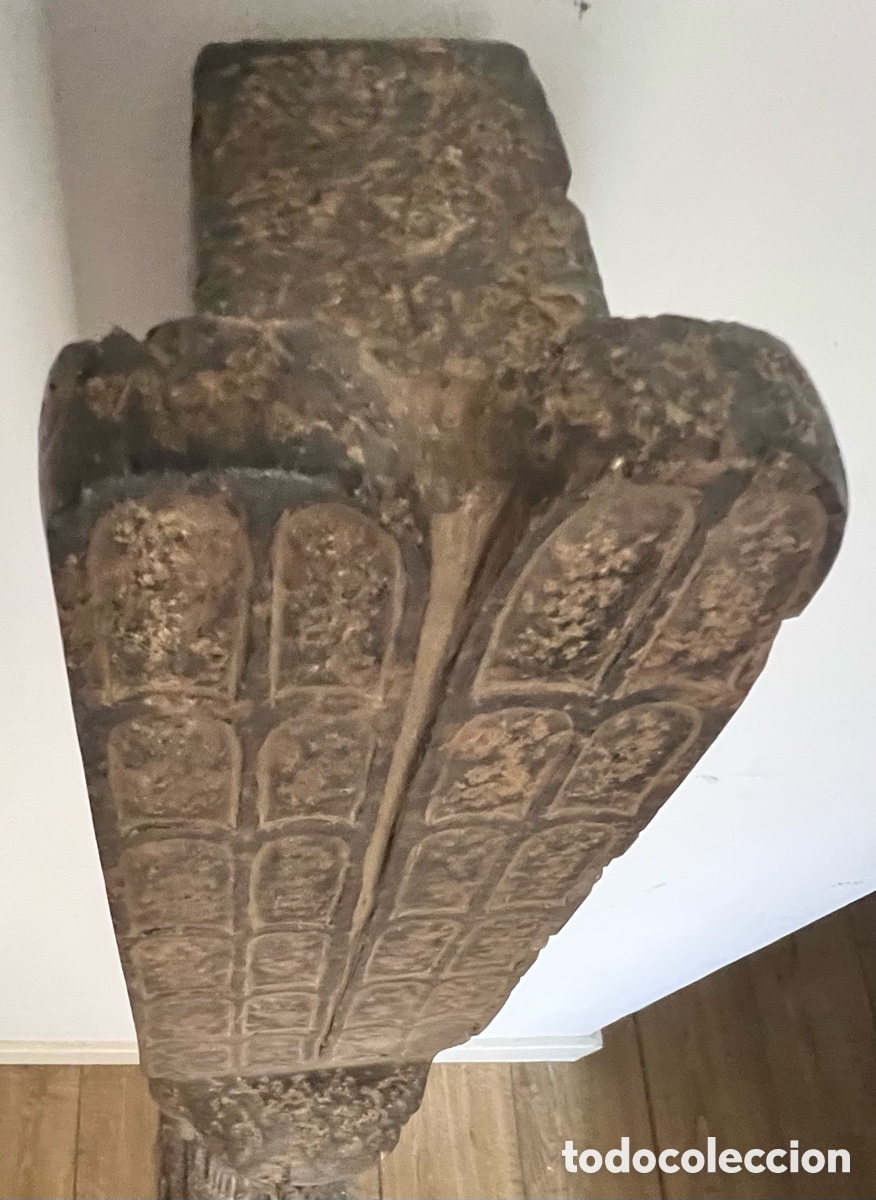
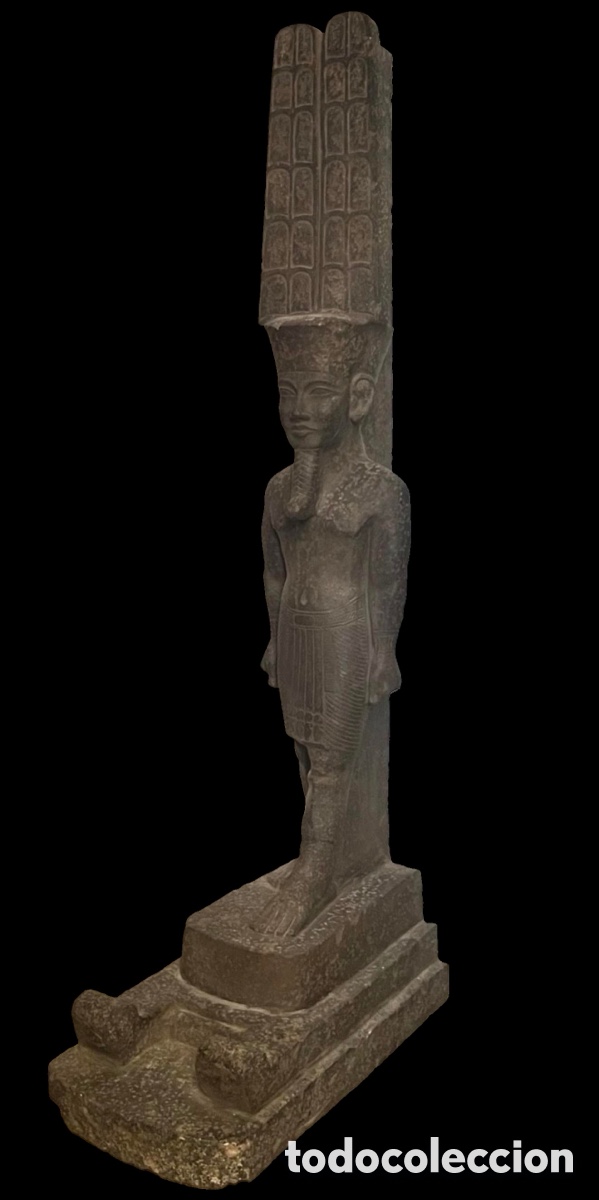
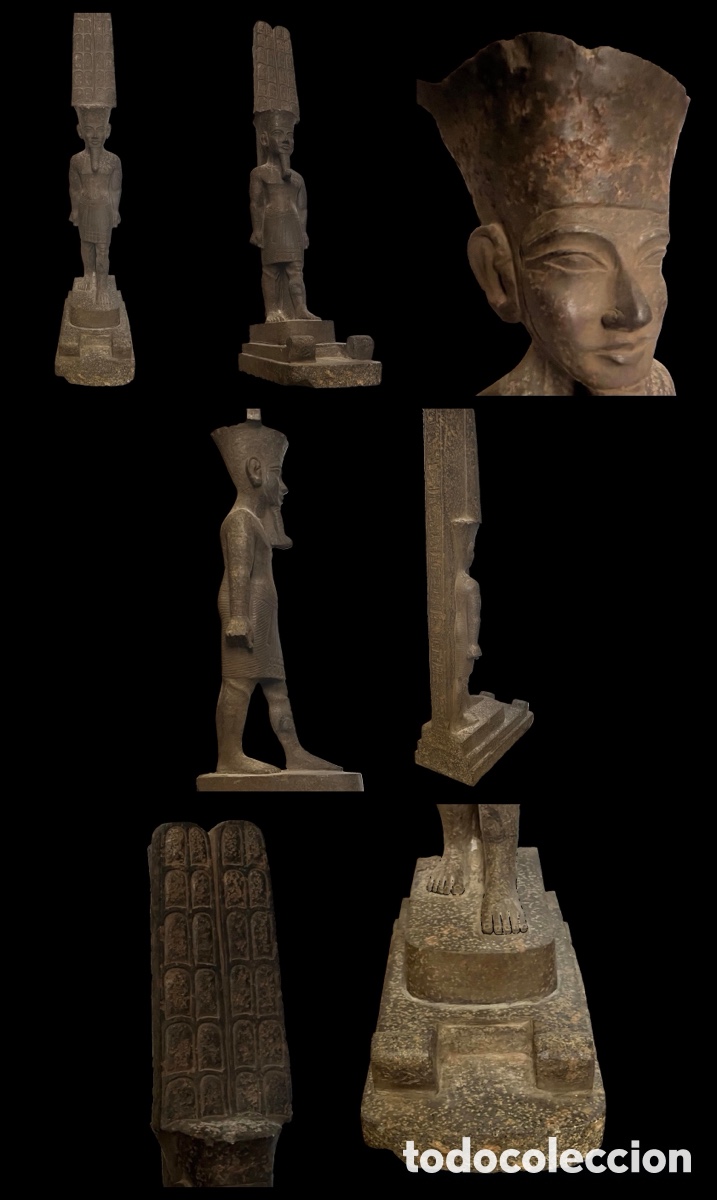
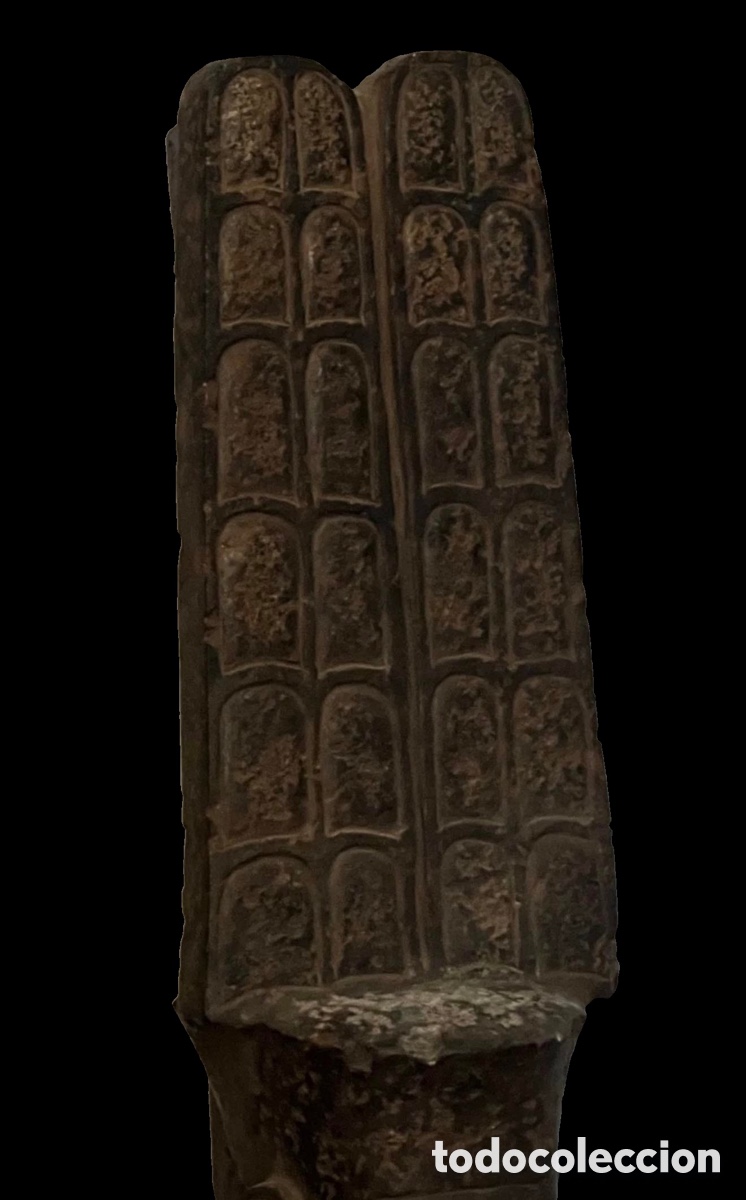
Large statue of Amun-Ra
“King of the Gods” and “Lord of the Thrones of the World”
He wears a double-feathered headdress.
He wears several pieces of jewelry, including a wide necklace, bracelets, and armlets.
His attire is a short skirt (Shenti).
He holds an ankh in his right hand and a scepter in his left.
Medium: Granite
Measurements:
110 cm high
50 cm wide
25 cm long
Weight: 90 kg
Private Collection
Protector of the pharaohs, source of fertility, and creator of the universe, Amun began as a local deity of Thebes, associated with air and the invisible.
After the expulsion of the Hyksos in the 16th century BC, his cult strengthened and merged with Ra, the solar god of Heliopolis.
Thus was born Amun-Ra, considered the guarantor of cosmic order and the legitimacy of the pharaohs.
During the New Kingdom (c. 1550-1070 BCE), Egypt underwent a religious and political transformation in which the god Amun-Ra consolidated his position as the principal deity of the Egyptian pantheon. His rise was the result of a theological and political strategy designed to unify divine and royal power under a single figure.
Amun, originally a local god of Thebes, merged with Ra, the ancient sun god of Heliopolis, creating a syncretized deity that combined the creative power of the sun with the hidden and mysterious authority of Amun. This process reflected the need to legitimize Theban rule over all of Egypt, especially after the expulsion of the Hyksos and the establishment of the 18th Dynasty. Pharaohs such as Amenhotep I, Thutmose III, and Ramses II actively promoted the cult of Amun-Ra, erecting monumental temples like Karnak and endowing it with riches that reinforced his status as protector of the state.
The cult of Amun-Ra not only defined the spirituality of the New Kingdom but also left a lasting legacy in the history of Egypt. His temple at Karnak remains one of the largest religious complexes of the ancient world, and its influence extended beyond Egyptian borders, especially into Nubia and Libya.
During the Opet Festival, one of the most important religious celebrations in ancient Egypt, dedicated to the Theban Triad: Amun-Ra, Mut, and Khonsu, the statue of Amun was transported to the temple at Luxor.
It was held annually during the Nile's inundation season (Akhet) and its purpose was to reaffirm the union between the pharaoh and the god Amun-Ra, guaranteeing the legitimacy of royal power.
It was celebrated in Thebes, with processions from the Temple of Karnak to the Temple of Luxor, along the Avenue of Sphinxes (3 km).
It originally lasted 11 days during the 18th Dynasty and, during the Ramesside period, extended to 27 days.
The central ritual was the transfer of the statues of Amun-Ra, Mut, and Khonsu on sacred barges, accompanied by priests, music, and dances.
The festival renewed the pharaoh's vital force, as he was considered the son of Amun, and reinforced Maat (cosmic order).
Gran estatua de AMÓN-RA
“Rey de los Dioses” y “Señor de los Tronos del Mundo”
Lleva un tocado de doble pluma.
Usa varias piezas de joyería, incluyendo un collar ancho, brazaletes y armlets.
Su vestimenta es una falda corta (Shenti)
Sostiene un ankh en su mano derecha y un cetro en su mano izquierda.
Medium: Granito
Medidas:
110 cm de alto
50 cm. de ancho
25 cm. de largo
Peso: 90 Kg.
Colección Privada
Protector de los faraones, fuente de fertilidad y creador del universo
Amón comenzó como una divinidad local de Tebas, asociado al aire y lo invisible.
Tras la expulsión de los hicsos en el siglo XVI a.C., su culto se fortaleció y se fusionó con Ra, el dios solar de Heliópolis.
Así nació AMÓN-RA, considerado el garante del orden cósmico y la legitimidad de los faraones.
Durante el Imperio Nuevo (c. 1550-1070 a.C.), Egipto experimentó una transformación religiosa y política en la que el dios Amón-Ra se consolidó como la deidad principal del panteón egipcio. Su ascenso fue el resultado de una estrategia teológica y política diseñada para unificar el poder divino y real bajo una misma figura.
Amón, originalmente un dios local de Tebas, se fusionó con Ra, el antiguo dios solar de Heliópolis, creando una deidad sincretizada que combinaba el poder creador del sol con la autoridad oculta y misteriosa de Amón. Este proceso reflejaba la necesidad de legitimar el dominio tebano sobre todo Egipto, especialmente después de la expulsión de los hicsos y el establecimiento de la XVIII Dinastía. Los faraones, como Amenhotep I, Tutmosis III y Ramsés II, promovieron activamente el culto a Amón-Ra, erigiendo templos monumentales como Karnak y dotándolo de riquezas que reforzaban su estatus como protector del Estado.
El culto a Amón-Ra no solo definió la espiritualidad del Imperio Nuevo, sino que dejó un legado perdurable en la historia de Egipto. Su templo en Karnak sigue siendo uno de los complejos religiosos más grandes del mundo antiguo, y su influencia se extendió más allá de las fronteras egipcias, especialmente en Nubia y Libia.
Durante el Festival de Opet que fue una de las celebraciones religiosas más importantes del antiguo Egipto, dedicada a la tríada tebana: Amón-Ra, Mut y Jonsu. La estatua de Amon era transportada hasta el templo de Luxor.
Se realizaba cada año durante la estación de la inundación del Nilo (Akhet) y tenía como propósito reafirmar la unión entre el faraón y el dios Amón-Ra, garantizando la legitimidad del poder real.
Se festejaba enTebas, con procesiones desde el templo de Karnak hasta el templo de Luxor, a lo largo de la avenida de esfinges (3 km).
Duraba Originalmente 11 días en la dinastía XVIII y en época ramésida llegó a extenderse hasta 27 días.
El Ritual central era el Traslado de las estatuas de Amón-Ra, Mut y Jonsu en barcas sagradas, acompañadas por sacerdotes, música y danzas.
El festival renovaba la fuerza vital del faraón, considerado hijo de Amón, y reforzaba la maat (orden cósmico).

Espanha (Málaga)


 Español
 English
 Deutsch
 Français
 Português
 Italiano