


Dos figuras funerarias de Ptah-Sokar-Osiris
Medium: madera de sicomoro con estuco y policromadas
Authentische antike USCHEPTI Figur Ägypten seit 1965 in deutscher Privatsammlung
Medidas: 39 cm. y 38 cm. de alto respectivamente
Colección Privada
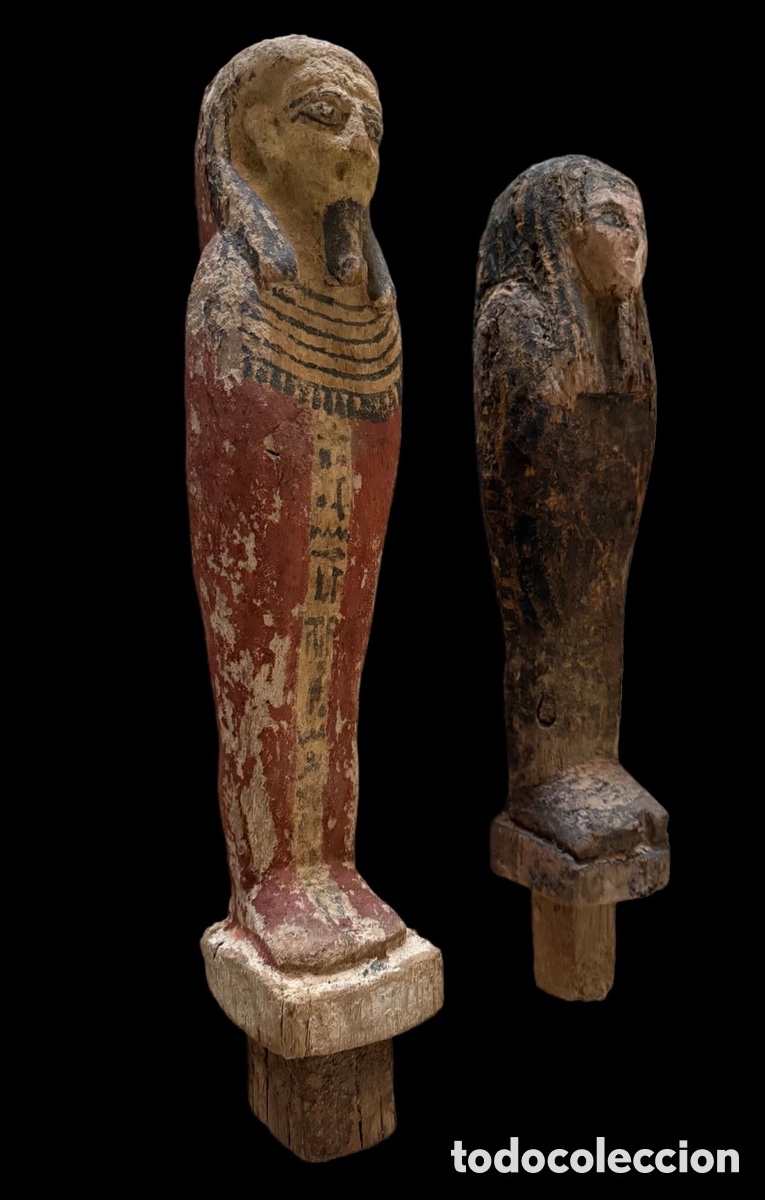
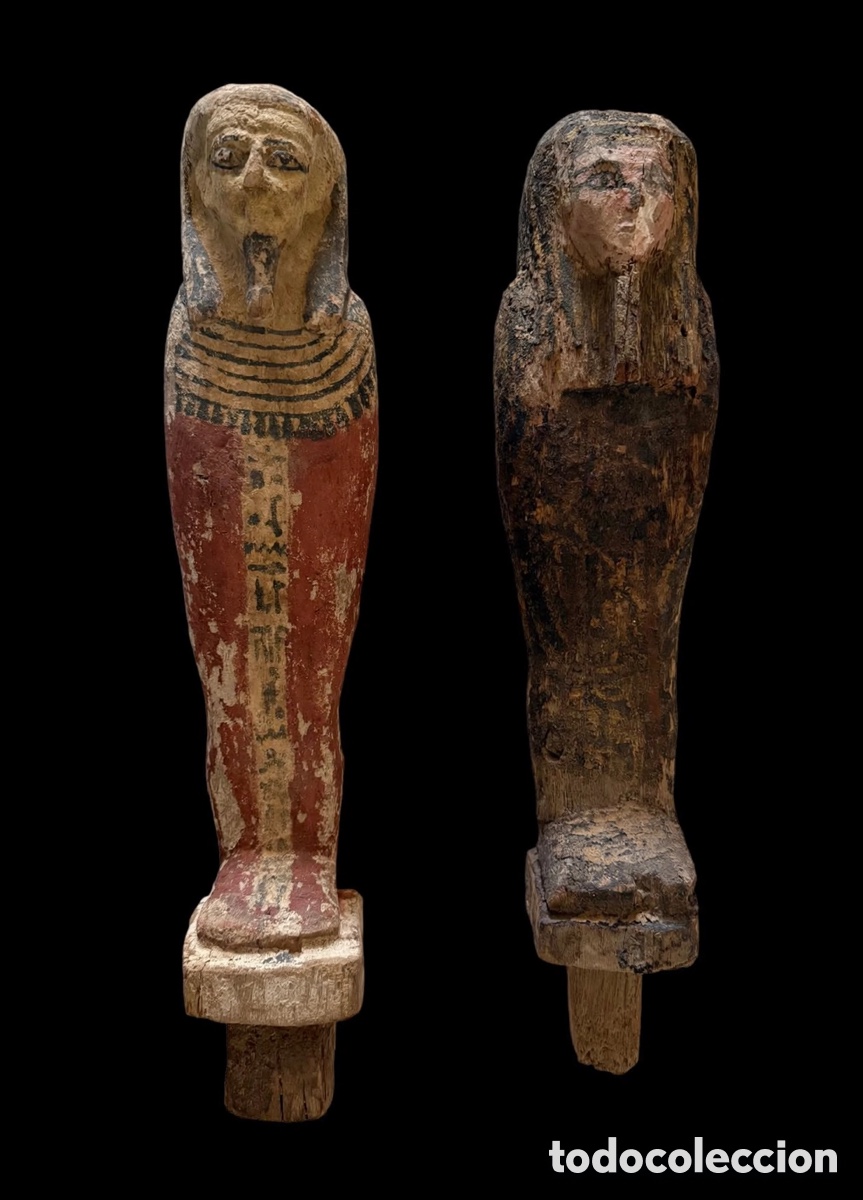
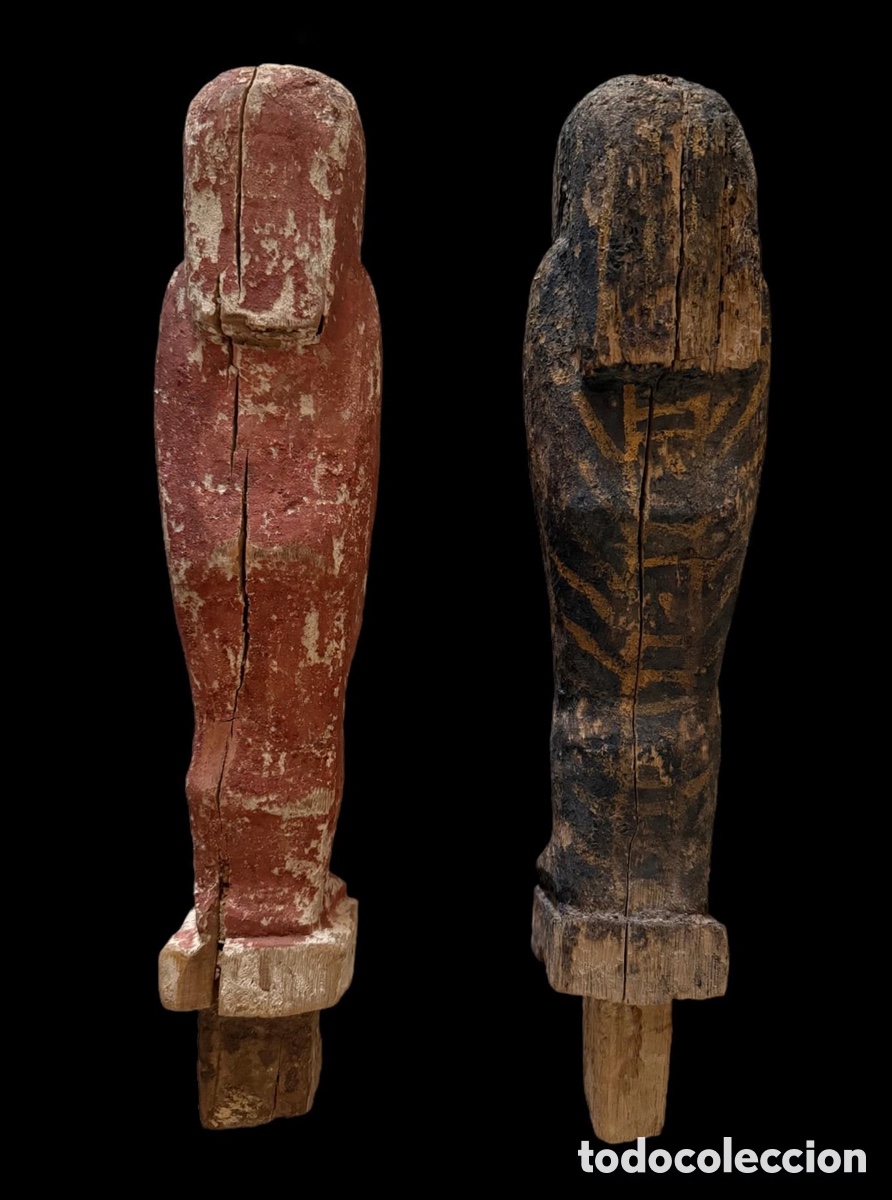
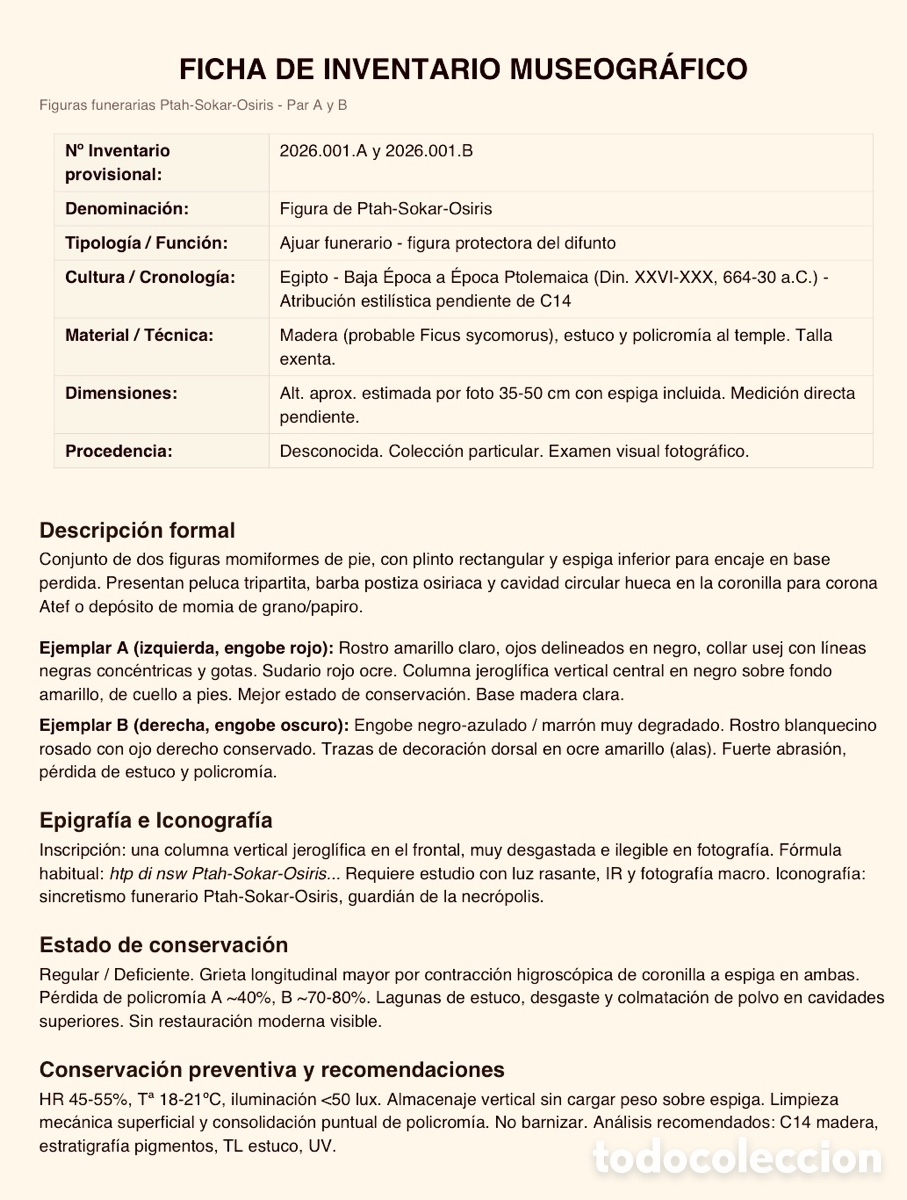
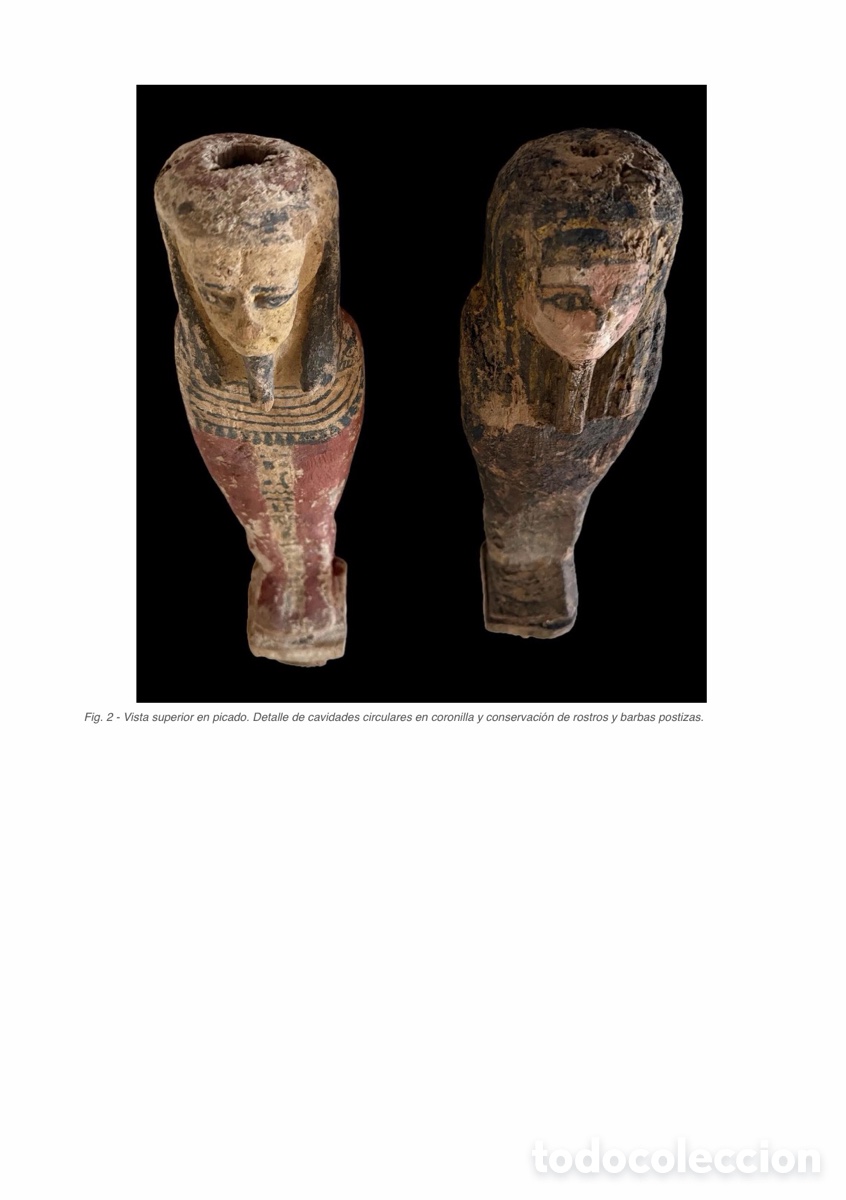
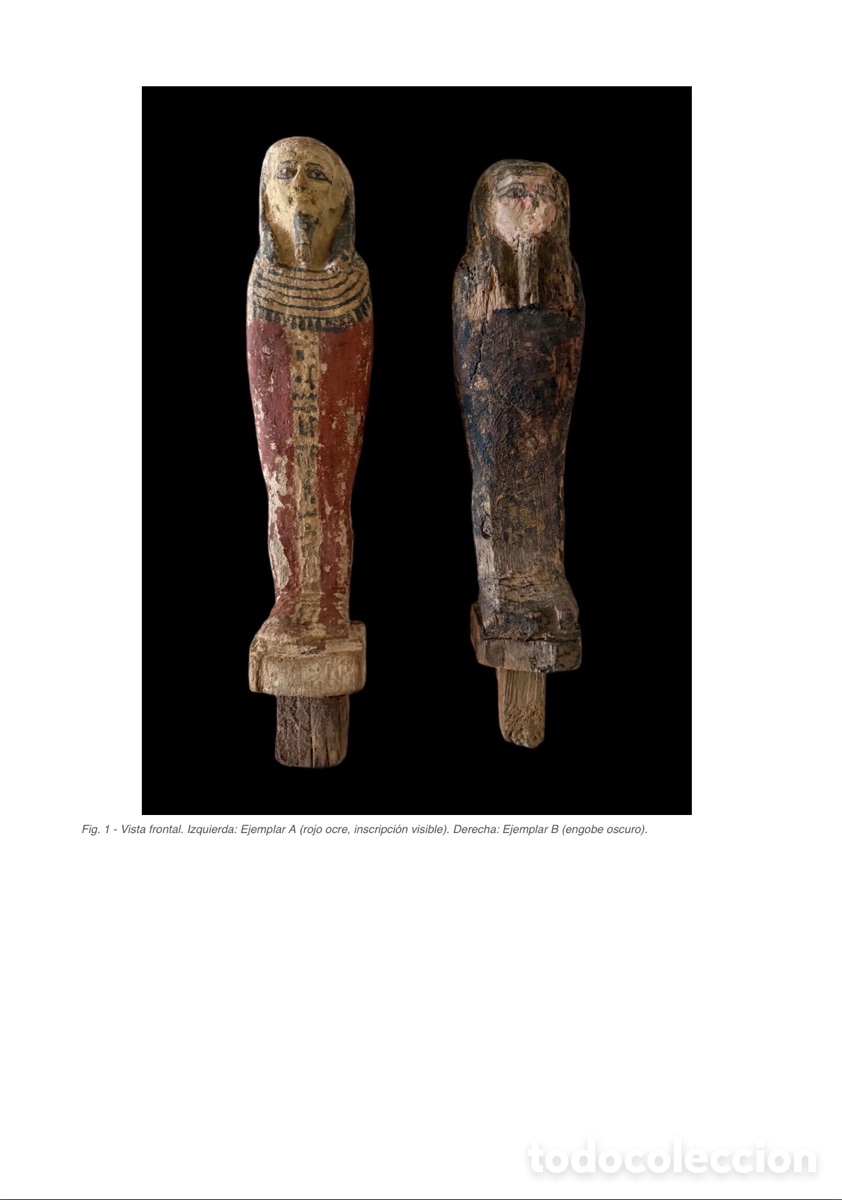
Dos figuras funerarias de madera del Antiguo Egipto, del tipo Ptah-Sokar-Osiris, fotografiadas sobre fondo negro desde tres ángulos diferentes.
Son figuras momiformes — de pie, con los pies juntos, sin brazos definidos — talladas en madera, con una capa de estuco y pintura polícroma. Las dos tienen un plinto rectangular en la base y por debajo una espiga o clavija de madera, que servía para encajarlas en una base separada.
Imagen 1 - Vista frontal
Figura de la izquierda:
• Cara de color amarillo crema, con ojos y cejas delineados en negro, y peluca tripartita negra.
• Barba postiza divina en el mentón.
• Un collar ancho alrededor del cuello pintado con líneas concéntricas negras sobre fondo amarillo y una hilera de puntitos negros en el borde inferior.
• El sudario / cuerpo está pintado en rojo ocre mate, dejando ver el estuco blanco y la madera, sobre todo en las piernas.
• Una columna vertical de jeroglíficos en negro sobre fondo amarillo baja por el centro, desde el collar hasta los pies.
• La madera está agrietada pero la forma se conserva bastante bien. La base es de madera clara.
Figura de la derecha:
• Mucho más oscura y erosionada. El cuerpo es casi negro / marrón oscuro, con restos de azul oscuro y ocre.
• La cara es más clara, blanquecina rosada, con un ojo todavía bien visible pintado en negro. La barba y la peluca están muy desgastadas.
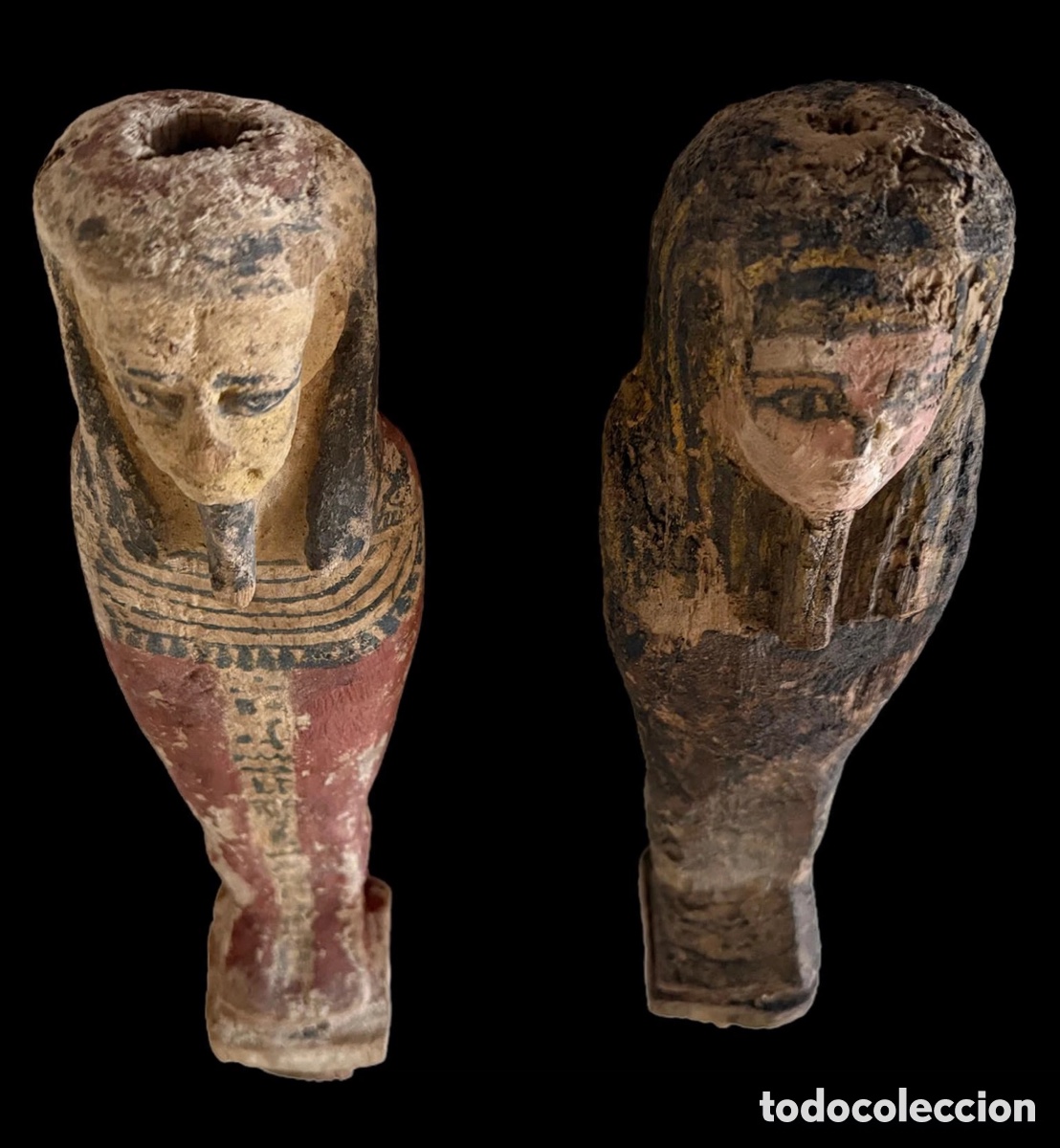
Imagen 2 - Vista superior en picado
Este ángulo muestra la parte superior de las cabezas.
Las dos figuras tienen una cavidad circular hueca en la coronilla. Es característico de las figuras Ptah-Sokar-Osiris — ahí se colocaba una corona Atef o se guardaba en su interior una pequeña momia de grano o un papiro.
• En la de la izquierda, la cara más de frente, la barba proyectada hacia delante y el patrón del collar más nítido.
• En la de la derecha, con restos amarillos y negros en la cabeza y la mejilla, y el ojo pintado.
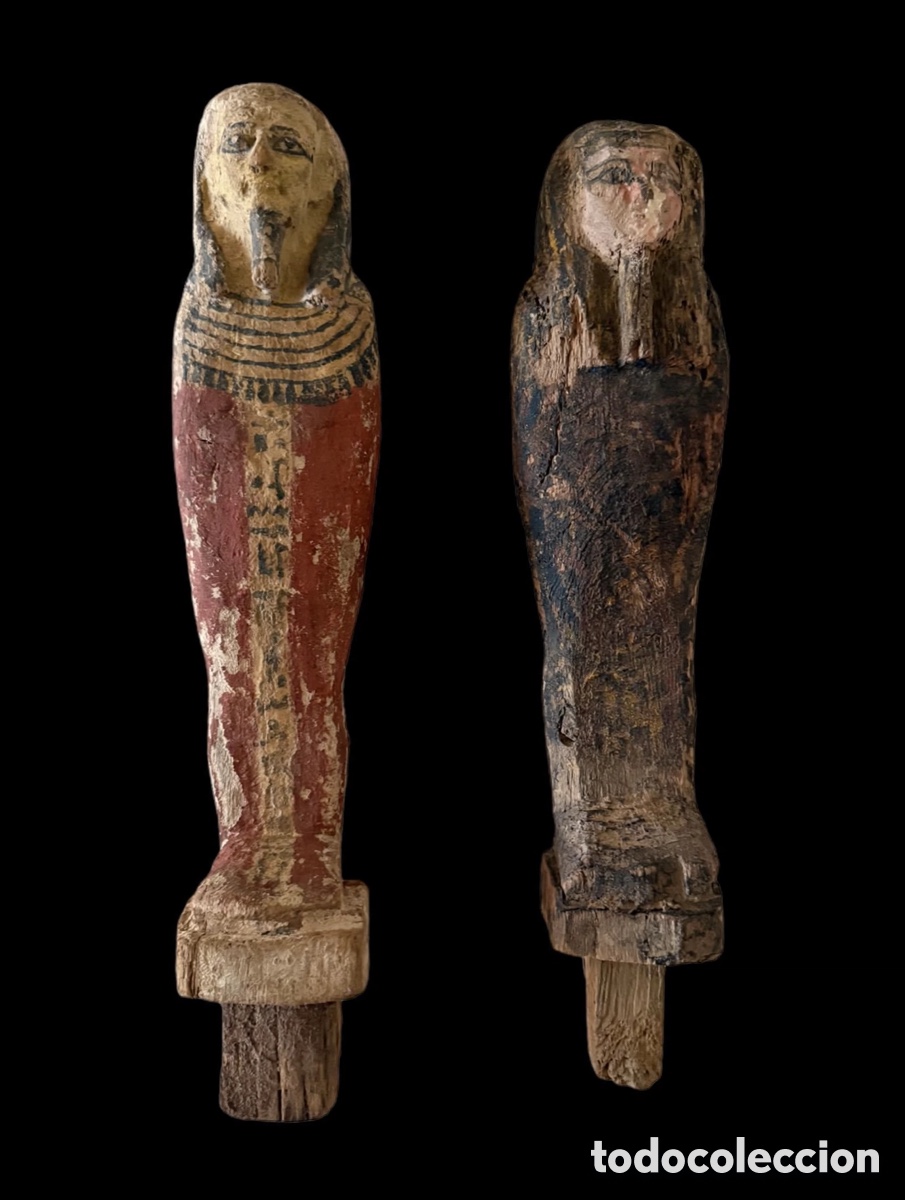
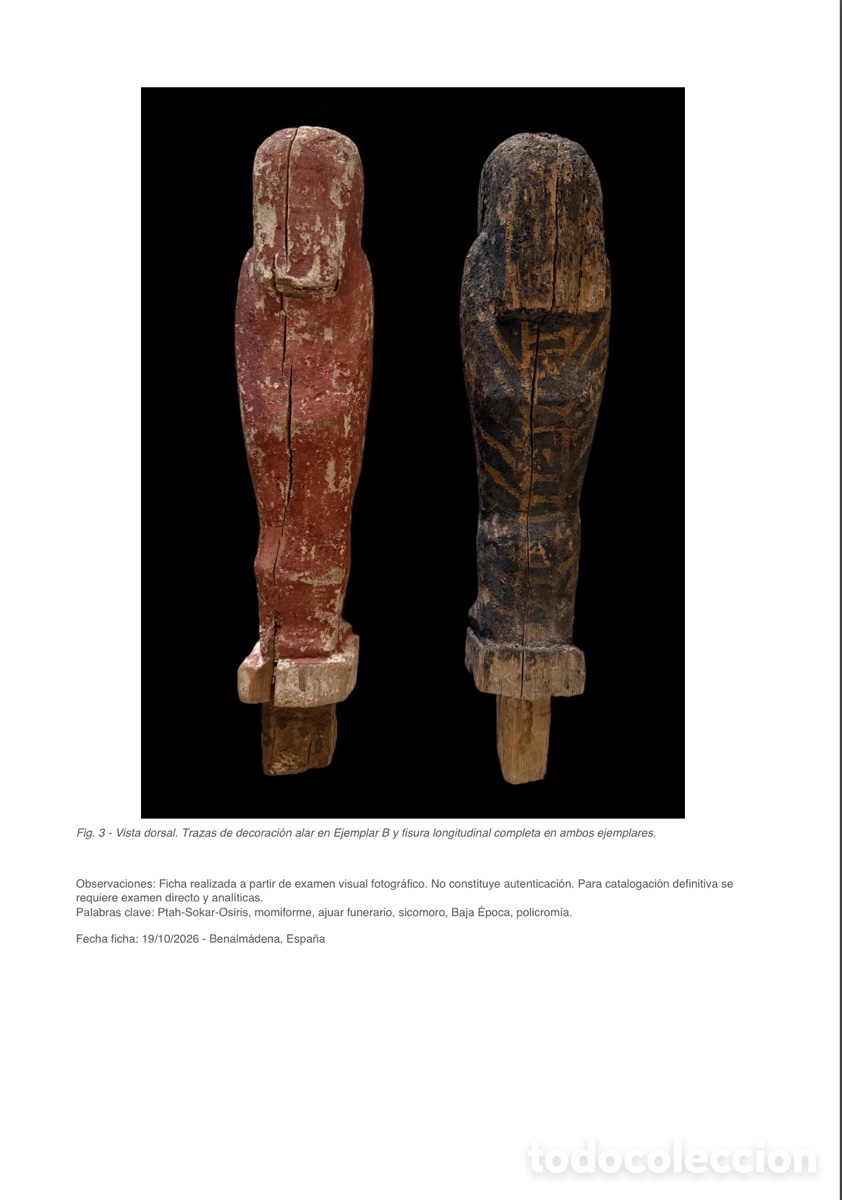
Imagen 3 - Vista trasera
• Trasera izquierda: Casi toda en rojo ocre.. Una grieta vertical profunda recorre toda la figura desde la cabeza hasta la base y la espiga. La parte posterior de la cabeza es maciza y en bloque.
• Trasera derecha: Marrón oscuro / negro con decoración amarilla se intuyen trazos en ocre amarillo de alas y patrones geométricos sobre el fondo oscuro, típicos de las alas de Sokar en la espalda. La misma grieta larga vertical en el centro, de cabeza a plinto.
Estado común:
Las dos muestran desgaste propio de madera antigua: fisuras longitudinales, abrasión, descascarillado de la pintura, pérdida de detalle y madera vista en las bases. La iluminación de estudio hace muy visible la textura del estuco y de la veta.
En cuanto a función, este tipo de figuras se colocaban en tumbas del Periodo Tardío al Ptolemaico, ca. 664-30 a.C., como guardianes de la necrópolis y representan al dios sincrético Ptah-Sokar-Osiris.
FICHA DE INVENTARIO - COLECCIÓN EGIPCIA
Nº de Inventario provisional: 2026.001.A y 2026.001.B
Denominación: Figura de Ptah-Sokar-Osiris
Otra denominación: Ptah-Sokar-Osiris, figura funeraria momiforme
Tipología / Función: Ajuar funerario - figura de protección del difunto
Conjunto: Par de figuras con espiga de encaje
Cultura: Egipto faraónico
Cronología: Baja Época - Época Ptolemaica
Datación estilística: Dinastía XXVI - XXX / Ptolemaica, 664 - 30 a.C. - Pendiente de análisis arqueométrico C14 y de pigmentos para confirmación
Material: Madera [probable Ficus sycomorus - sicomoro] + estuco
Técnica: Talla en madera, estucado, policromía al temple
Two Ptah-Sokar-Osiris funerary figures
Medium: sycamore wood with stucco and polychrome paint
Authentic ancient Egyptian *ushabti* figure; in a private German collection since 1965
Dimensions: 39 cm and 38 cm in height, respectively
Private Collection
Two ancient Egyptian wooden funerary figures of the Ptah-Sokar-Osiris type, photographed against a black background from three different angles.
These are mummiform figures—standing with feet together and no distinct arms—carved from wood, covered with a layer of stucco and polychrome paint. Both feature a rectangular plinth at the base, with a wooden tenon or peg underneath, designed to fit into a separate base.
Image 1 - Front view
Figure on the left:
• Cream-yellow face, with eyes and eyebrows outlined in black, and a black tripartite wig.
• A divine false beard on the chin.
• A wide collar around the neck, painted with concentric black lines on a yellow background, with a row of small black dots along the lower edge.
• The shroud/body is painted in a matte ochre-red; the white stucco and the underlying wood are visible, particularly on the legs.
• A vertical column of black hieroglyphs on a yellow background runs down the center, from the collar to the feet.
• The wood is cracked, but the overall form is well-preserved. The base is made of light-colored wood.
Figure on the right:
• Much darker and more eroded. The body is nearly black/dark brown, with traces of dark blue and ochre.
• The face is lighter—a pinkish off-white—with one eye still clearly visible, painted in black. The beard and wig are heavily worn.
Image 2 - Top-down view
This angle shows the tops of the heads. Both figures feature a hollow, circular cavity at the crown of the head. This is a characteristic feature of Ptah-Sokar-Osiris figures; such cavities were used to hold an *Atef* crown, or to contain a small "grain mummy" or a papyrus scroll.
• The figure on the left has a more forward-facing orientation, a beard that projects outward, and a more clearly defined collar pattern.
• The figure on the right retains traces of yellow and black pigment on the head and cheek, and the eye remains painted.
Image 3 – Rear view
• Rear (left figure): Mostly covered in red ochre. A deep vertical crack runs the entire length of the figure, from the head down through the base and the tenon. The back of the head is solid and block-like.
• Rear (right figure): Dark brown/black with yellow decoration; faint traces of yellow ochre—depicting wings and geometric patterns—are visible against the dark background. These are characteristic of the wings of Sokar, typically shown on the back. A similar long, vertical crack runs down the center, from the head to the plinth.
General condition:
Both figures exhibit wear consistent with ancient wood: longitudinal fissures, abrasion, flaking paint, loss of detail, and exposed wood at the bases. Studio lighting highlights the texture of the stucco and the wood grain.
Regarding their function, these types of figures were placed in tombs dating from the Late Period to the Ptolemaic Period (c. 664–30 BC). They served as guardians of the necropolis and represent the syncretic deity Ptah-Sokar-Osiris. INVENTORY RECORD - EGYPTIAN COLLECTION
Provisional Inventory No.: 2026.001.A and 2026.001.B
Designation: Figure of Ptah-Sokar-Osiris
Alternative designation: Ptah-Sokar-Osiris, mummiform funerary figure
Typology / Function: Funerary equipment – protective figure for the deceased
Set: Pair of figures with a tenon for insertion
Culture: Pharaonic Egypt
Chronology: Late Period – Ptolemaic Period
Stylistic dating: 26th–30th Dynasty / Ptolemaic, 664–30 BC – Awaiting archaeometric analysis (C14 and pigment analysis) for confirmation
Material: Wood (likely *Ficus sycomorus* – sycamore fig) + stucco
Technique: Wood carving, stucco application, polychrome tempera painting.

Espanha (Málaga)


 Español
 English
 Deutsch
 Français
 Português
 Italiano